
Vegas Crime Simulator
Naxeex Action & RPG GamesAction
4.19.76K Reviews
- Version
- 6.6.9
- Installs
- 100.00M
- Age Rating
- Mature 17+
Screenshots



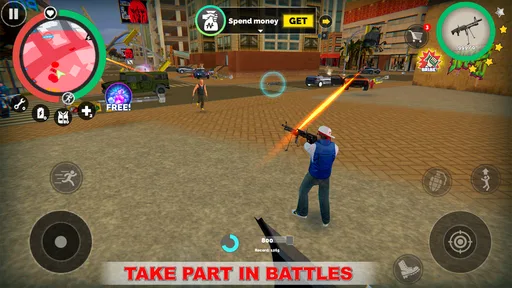
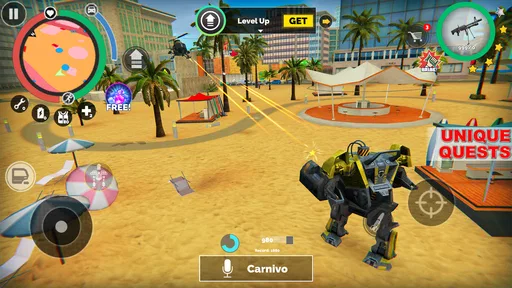
Our Review of Vegas Crime Simulator
 Analysis by Appyee
Vegas Crime Simulator is the kind of action game I open when I want a short, noisy escape rather than a carefully paced adventure. Its central appeal is simple: I can move through a crime-themed city, take on missions, get involved in gang conflicts, and use stolen cars to keep the action moving. That freedom gives it a different feel from a straight level-by-level shooter, even though the rough edges are always close to the surface.
What kept me playing was the ability to turn an ordinary trip across the city into an unscripted problem. A mission may send me somewhere, but the journey itself can become just as important as the objective. I might need a faster vehicle, run into enemies, or decide that escaping is smarter than trying to win every fight. The real strength is the freedom to improvise between missions, not deep storytelling or polished simulation.
Developed by Naxeex Action & RPG Games, this free Android action game has built a large audience, with over a hundred million installs and an average rating of 4.1 from around one and a half million ratings. Those figures make sense to me: the basic idea is immediately understandable, and the game offers the familiar fantasy of rising through a dangerous city without asking for a long tutorial before the action starts.
Why the open-ended crime sandbox matters
The most important capability here is the combination of missions and free movement. In a conventional action game, the next objective usually controls the entire experience. Here, the mission gives me direction, but the city gives me room to make mistakes, change plans, and create my own small stories. That difference sounds modest, yet it changes how I use the game on a phone.
I can play with a clear goal when I have only a few minutes, or ignore the immediate task and experiment with vehicles, routes, and fights. This makes the game more flexible than a purely linear action title. It is also why I would not judge it only by the quality of an individual mission. The larger question is whether the surrounding city keeps me interested after the objective is complete.
The setting is built around gang warfare and criminal progression, so the tone is deliberately aggressive. Combat, car theft, and confrontations are not occasional side activities; they are the language of the game. The mature 17+ rating is therefore important for families deciding whether it belongs on a shared device. I would not recommend treating it as a harmless cartoon-style open-world game simply because it runs on a mobile phone.
At the same time, the open structure has limits. I do not get the same depth of character writing, world simulation, or mission variety that I would expect from a large console or PC crime sandbox. The attraction is accessibility and immediate action. If I want a rich narrative with carefully staged consequences, this is not the best alternative. If I want to cause trouble, grab a car, and start another objective quickly, it is much more suitable.
How I approach missions without wasting time
My first useful habit is to treat the vehicle as part of the mission rather than as decoration. When I leave a safe position, I try to think about the return route as well as the destination. A car that is convenient at the beginning may be a poor choice once enemies appear, so I avoid driving deep into crowded areas without considering where I can turn around or escape.
This small change makes the missions feel less random. Instead of rushing directly toward every marker, I use the city as a resource. I look for a route that lets me approach quickly, complete the objective, and leave before a fight becomes unnecessarily expensive in time or health. The game does not need a complex tactical system for this to matter; the open layout itself creates the decision.
I also try not to fight every opponent I see. The temptation is understandable because combat is the loudest part of the experience, but constant confrontation can turn a simple trip into a long interruption. When the objective is movement or arrival, avoiding trouble can be more effective than proving I can defeat everyone nearby. That is one of the less obvious lessons of the sandbox: freedom includes the option to disengage.
For players who are new to this type of mobile game, I suggest spending the first session learning the rhythm of travel, combat, and escape rather than chasing perfect results. The controls and action can feel more manageable once I stop treating every encounter as a separate challenge. I use early missions to learn how quickly a situation becomes crowded and how much time I need to recover from a bad decision.
A realistic short-session use case
Imagine having a commute break or a few minutes before an appointment. I would start with one mission instead of promising myself a long campaign session. I can travel to the objective, deal with whatever resistance appears, and stop after the immediate task. If I have more time, I can continue exploring, but the game does not require a large uninterrupted block of attention to make sense.
This is where the open-world structure works well on mobile. A linear game may leave me at an awkward checkpoint when I need to put the phone away. Here, I can decide that reaching a safe area or finishing a small objective is a satisfying stopping point. The trade-off is that the experience can feel less focused. If I prefer games that always tell me exactly what to do next, the extra freedom may feel like wandering rather than value.
Another practical scenario is playing with sound turned down in a public place. The visual action remains understandable, but the game is more enjoyable when I can follow the pace of the encounter without distractions. I would not choose it for a quiet environment where sudden violence or mature themes could be uncomfortable, especially given its age classification.
Where it sits beside other action games
Compared with a traditional mission-based shooter, this game gives me more room to travel and experiment, but usually less precision and polish. A focused shooter is often better when I want tight aiming, carefully balanced encounters, and a clear sequence of set pieces. Vegas Crime Simulator is better when I want the mission to be only one part of the session.
Compared with premium open-world crime games on consoles or computers, it is easier to pick up and does not require an upfront purchase because the game is free. However, I should lower my expectations about visual refinement, systemic depth, and storytelling. The mobile format and broad action focus make it approachable, but they also explain why some interactions can feel rougher than the alternatives.
It also differs from competitive multiplayer action games because the appeal is not primarily about matching my skill against another person. I can play at my own pace and create trouble without worrying about a ranked result. For someone who wants social competition, live opponents, or highly precise controls, another category of game would be a better fit.
The friction I noticed during longer play
The biggest weakness is repetition. Once the novelty of driving around and starting fights fades, the basic loop can become familiar: travel, confront enemies, complete the task, and repeat. The open city helps break that pattern, but it does not erase it. I enjoy the game more when I set a small personal goal, such as reaching an area efficiently or escaping a messy encounter, rather than expecting every mission to feel dramatically different.
Controls are another consideration. Touch input can make movement and combat feel less exact than a controller. That matters most when several threats appear at once or when I need to steer and react quickly. I can adapt, but players who are especially sensitive to imprecise mobile controls may find the action frustrating sooner than casual players do.
The free entry point is convenient, yet the presence of optional purchases changes how I think about progression and spending. Individual in-app items range from $0.99 to $199.90, so I would approach the purchase screen carefully and avoid treating optional boosts as necessary simply because the game presents them during play. My preferred method is to try the core experience first and decide whether it remains enjoyable without spending.
That advice is especially relevant for younger players. The mature rating already calls for parental judgment, and the broad purchase range means a shared device deserves sensible account controls. I would also make sure the person using the phone understands that “free” refers to downloading the game, not to every possible item inside it.
What the current release means for compatibility
The current version is 6.6.9, and it requires Android 6.0 or later. That makes checking the phone’s operating system a simple first step before downloading. On a compatible device, I would still leave enough storage and close demanding background apps if performance feels uneven, especially during busy action scenes. I would not assume that an older phone will deliver the same smooth experience as a newer one merely because the operating system requirement is met.
The game’s long presence on mobile helps explain why it is easy to recognize as a pick-up-and-play action title. It was released on June 3, 2015, so I approach it as an established mobile sandbox rather than a new technical showcase. That is useful context when comparing it with newer games: its appeal is the familiar crime-action formula and immediate accessibility, not a promise of cutting-edge presentation.
I also recommend deciding in advance what kind of session I want. If I am looking for a quick burst of driving and combat, the roughness is easier to overlook. If I am settling in for a long, immersive story, the repeated structure and mobile-style limitations become much more noticeable. The same game can feel entertaining or tiring depending on that expectation.
Who gets the most from the freedom
I think the best audience is someone who enjoys open-ended action but does not need every activity to be deeply developed. You will probably appreciate being able to move from a mission into spontaneous trouble, steal a car, and recover from a poor plan without restarting a carefully scripted chapter. The game is also a reasonable choice for players who want a free alternative to more expensive open-world crime games and are comfortable with a simpler presentation.
It is less suitable for anyone seeking a serious crime drama, realistic driving, or a highly polished combat system. I would also suggest skipping it if mature violence is a concern, if you dislike optional purchase prompts, or if repetitive objectives quickly lose your attention. A structured action game may serve you better when you want consistent pacing and fewer distractions.
For me, the smartest way to enjoy it is to use the city as a playground rather than demand that it behave like a full console-scale simulation. I plan routes, choose when to fight, and accept that some encounters will be rough around the edges. That mindset turns the open-ended design into a genuine advantage instead of making every limitation feel like a failure.
Vegas Crime Simulator works best as a compact, chaotic mobile sandbox: free to start, easy to understand, and flexible enough for short sessions. Its missions provide direction, while the ability to travel, steal cars, and improvise creates the moments I remember. I would recommend it to adults who want uncomplicated crime-themed action and can accept repetition, touch-control compromises, and optional purchases. For a deeper story or more refined open-world experience, I would choose a different game; for quick unscripted trouble on Android, this one still has a clear place.
Verdict
Strengths of Vegas Crime Simulator
- Large open-world map with plenty of places to explore.
- Wide selection of weapons and vehicles to experiment with.
- Simple controls make movement and combat easy to learn.
- Fun physics create unpredictable moments during missions.
- Offline play lets you enjoy the game without an internet connection.
Limitations of Vegas Crime Simulator
- Frequent ads can interrupt gameplay and slow down progression.
- Graphics look dated compared with newer open-world action games.
- Mission objectives can become repetitive after extended play.
- Some controls feel imprecise during driving and shooting.
- In-app purchases may be needed to unlock upgrades more quickly.
Similar Picks in This Category
View All
Temple Run 2: Endless Escape
Imangi Studios4.1

PUBG MOBILE
Level Infinite4.3

Free Fire: 9th Anniversary
GARENA INTERNATIONAL I4.4

Talking Tom: Hero Dash Run
Outfit7 Limited4.3

slither.io
Lowtech Studios3.9

Sniper 3D:Gun Shooting Games
Wildlife Studios4.6
Frequently Asked Questions
What is Vegas Crime Simulator about?
Vegas Crime Simulator is an open-world action game set in a fictional version of Las Vegas. You play as a criminal character who can explore the city, complete missions, fight rival gangs, steal or drive vehicles, and use different weapons and abilities. The game focuses on free-roaming gameplay, allowing you to follow objectives or simply cause chaos around the map.
Is Vegas Crime Simulator free to download and play?
The game is generally available to download for free, but the experience may include advertisements, optional in-app purchases, or both, depending on the platform and version. Some purchases can help unlock items, currency, weapons, or other advantages more quickly. Before downloading, check the store listing and your device’s purchase settings, especially if children may use the device.
Can Vegas Crime Simulator be played offline?
Vegas Crime Simulator is primarily designed as a single-player experience and many of its core activities can usually be enjoyed without a constant internet connection. However, online access may still be required for advertisements, updates, store features, or certain services. Availability can vary by version, so it is best to launch the game once while connected before relying on offline play.
Is Vegas Crime Simulator suitable for children?
The game is aimed at mature players because it includes crime-themed missions, violence, weapons, car theft, police chases, and other adult-oriented action. It may also display advertisements or offer in-app purchases. Parents should review the age rating shown in the relevant app store and consider enabling purchase restrictions or parental controls before allowing younger players to install it.
What devices are required to run Vegas Crime Simulator smoothly?
Because Vegas Crime Simulator features a 3D open-world environment, vehicles, characters, and action effects, performance depends on your device’s hardware. A relatively recent Android phone or iPhone with sufficient free storage and updated system software should provide a better experience. Older or entry-level devices may show longer loading times, reduced graphics quality, frame-rate drops, or occasional crashes.
Play our best games!


